


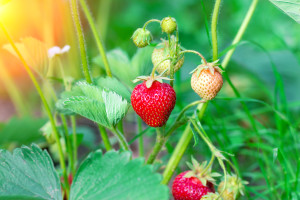
 Are you a strawberry lover? If so, you are part of the vast number of Americans who enjoy one of the most popular, refreshing, and healthy natural treats on the planet!
All fruits shine with rich colors, signifying they are bursting with antioxidants that help fight disease and benefit your health! Strawberries are no exception, plus they are rich in fiber, vitamins and minerals…which include folate, potassium, manganese, magnesium, and are one of the highest fruits in Vitamin C. Is it any wonder they have won the title as one of the top 10 “super foods”!
Armed with this information, you may not be surprised that Americans consume about eight pounds of strawberries per year -nearly four times as much compared to 1980. But what you may not know is that we are also consuming dozens of pesticides, including chemicals that have been linked to cancer, neurological problems, and shown to disrupt our hormones and reproductive systems. (Many of these chemicals have been banned in Europe.)
Years ago I loved picking strawberries by the bushel each Summer…and the excitement and enjoyment that came once a Season, and now they are available anytime. Ever wonder what may have changed over the past decades to allow that to happen? Sadly, an increase in chemically-aided growing methods and use of pesticides are largely to thank for making strawberries available year round. Strawberry growers in particular, have been found to use jaw-dropping volumes of not only pesticides, but poisonous gases to sterilize their fields before planning, killing every pest, weed, and other living thing in the soil.
Here are a few Facts from the USDA’s 2014 testing of 176 batches of strawberries:
- Almost all samples – 98% – had detectable residues of at least one pesticide
- 40% had residues of 10 or more pesticides
- The dirtiest strawberry sample had residues of 17 different pesticides
- Strawberry growers used 60 different pesticides in various combinations
Want to know more and just how hazardous these chemicals are? Read the full report from the Environmental Working Group.
The report is short and a must-read to be informed. EWG is a non-profit, non-partisan organization dedicated to protecting human health and the environment. EWG is unique in that it offers reliable factual information that is not skewed by the government or big food companies.
So How Do You Reduce YOUR Exposure to Pesticides? …Go ORGANIC!
Just last month the Environmental Working Group (EWG) released the 2016 edition of the EWG’s Shopper’s Guide to Pesticides in Produce. For the first time, it elevated STRAWBERRIES to #1 on the top of the Dirty Dozen List! (It took the lead after conventionally grown apples topped the list for the past 5 years.)
So, to help keep you up to date, and give you the facts so you can be the most informed consumer… here is your own copy of the 2016 EWG’s Shopper’s Guide to Pesticides in Produce! For more information on Pesticides in Produce see my past blog post. Remember… organic produce is also free of GMO! If you read April’s newsletter, you may have hopped on the non-GMO bandwagon.
One of my favorite ways to “carry” my shopper’s guide with me, (to remember top fruit and veggies that are on the Dirty Dozen and the Clean 15 list) is by using the free app! Check it out and never leave home with out it!
Oh and by the way…
Please support our wonderful local farmers…many of which are certified organic or use less pesticides than other conventional growers. Check it out – What’s In Season in Florida in May!
Drop me a line and let me know if you found this to be helpful. Do YOU plan to use EWG’s Shopper Guide?!
Let’s strive together for Food Safety and Optimal Wellness!
~Julie
